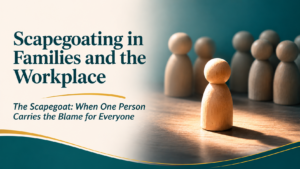
Scapegoating happens when a group places its collective tension, shame or dysfunction onto one person. That person is then blamed for problems that belong to the whole system. Blaming them lets everyone else avoid looking at what is really wrong.
Scapegoating in Families
In families, one child, and sometimes a partner, becomes the “problem one”. They are labelled difficult, too sensitive or the troublemaker, while another child may be idealised as the “golden child”.
Scapegoating is common in families affected by addiction, narcissistic parenting or unresolved trauma. The scapegoat absorbs the anxiety the family cannot face. In family systems theory they are often called the “identified patient”: their symptoms carry the family’s distress.
How the Role Shows Up in Adulthood
The role rarely ends in childhood. In adulthood, it can show up as:
- Chronic shame and self-doubt
- Hypervigilance and bracing for criticism
- People-pleasing and difficulty saying no
- Recreating the same dynamic at work and in relationships
Scapegoating in the Workplace
At work, one employee or team is blamed for failures that stem from poor leadership, unclear processes or a toxic culture. It often targets the person who speaks up, is different, or threatens the status quo.
Signs You May Be the Workplace Scapegoat
- You are excluded from meetings, decisions or conversations
- You are singled out for criticism
- Your mistakes are magnified while others’ are overlooked
- Gossip builds a shared “story” about you
Scapegoating protects managers and the group from accountability. The cost is high: it erodes trust, psychological safety and performance across the whole team.
The Truth About the Scapegoat
The scapegoat is not the cause of the dysfunction. They are where the system puts it.
If You Identify With This Role
Recognising that you have been the scapegoat is the first step to freeing yourself from it. Those old labels were never the truth about who you are. They were a story the system needed in order to avoid its own pain.
How to Overcome It
- Naming the pattern. Seeing clearly that you were carrying blame that didn’t belong to you.
- Separating your identity from the narrative. Questioning the beliefs you absorbed: “I’m the problem”, “I’m too much”, “It’s always my fault”.
- Calming the nervous system. Years in this role can leave you on high alert, braced for criticism. Havening, hypnosis and NLP help release that stored stress so you feel safe in yourself again.
- Setting boundaries. Learning to step out of the role, even when others try to pull you back into it.
- Rebuilding self-worth. Reconnecting with your strengths, your voice and your right to take up space.
Ready to Break the Pattern?
You don’t have to keep living out a role you never chose. If this resonates, get in touch to find out how we can work together to break the pattern and move forward with confidence.
Karen Thomas, Mind Coach at Change Your Life | www.karen-thomas.co.uk