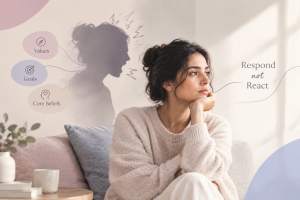
Anxiety Is Something We Do, Not Something We Have
Western culture has long treated anxiety as an illness: a malfunction of the brain, a serotonin deficiency, an affliction to be diagnosed and medicated. But having studied psychology and neuroscience, and worked as a psychotherapist with thousands of people diagnosed with “having anxiety,” I’ve seen a different picture. Most people who feel anxious or depressed are directed straight to antidepressants, because that’s the route our healthcare system defaults to.
It’s worth asking how we got here. How did this come about?
The Biomedical Model and Its Limits
For more than a century, the biomedical model — rooted in Louis Pasteur’s germ theory of disease — has dominated Western medicine. It holds that disease results from a biological defect, often triggered by a pathogen. This model was remarkably effective against the leading killers of the early 20th century, tuberculosis and diarrhoeal disease, helping raise life expectancy from 47 years in 1900 to 77 by 2000.
It was then applied to mental health with the same confidence. But over the past fifty years, the picture has shifted. The major causes of death today — stroke, heart disease, cancer — don’t respond to the biomedical model in the same way.
The Biopsychosocial Alternative
In 1977, George Engel proposed an alternative: the biopsychosocial model, which accounts for psychological and social factors alongside biology. It’s only in recent years that this model has started to gain real traction. Western healthcare remained entrenched in the purely biomedical view until quite recently, and several converging factors are now driving a paradigm shift.
The Downsides of Medication
1. It’s Not a Quick Fix
Most antidepressants take several weeks to have an effect, despite being reached for as an immediate solution.
2. Long-Term Efficacy Is Under-Studied
There’s a notable lack of research demonstrating how well these medications work over extended periods (Gelenberg et al., 2000).
3. No Ideal Antidepressant Yet Exists
Three persistent problems — intolerance, delayed onset of benefit, and limited efficacy — remain unresolved.
4. Discontinuation Can Be Difficult
A systematic review by Fava and colleagues found that up to 40% of patients reported new-onset symptoms after abruptly stopping SSRIs.
SSRIs are the most widely prescribed treatment for major depression, and while their efficacy is reasonable, they carry real costs:
-
Headaches
-
Disrupted sleep
-
Gastrointestinal changes
-
Sexual dysfunction
Some patients also experience heightened anxiety and agitation in the first days of treatment.
Why Psychological and Psychosensory Techniques Offer a Different Path
Neuroscience — including PET and MRI imaging — is increasingly showing evidence of the brain’s capacity for resilience and change. Techniques like relaxation training, breathwork, hypnosis, havening, meditation, and mindfulness offer benefits that medication typically doesn’t:
-
No side effects
-
Immediate, felt effects rather than a multi-week wait
-
Coping skills the person keeps and can use again
-
A sense of agency and empowerment, rather than reliance on a prescription
-
Physiological regulation — relaxation techniques that slow the heart rate; breathing techniques that support motivation and focus
-
Genuine neuroplasticity — the brain doesn’t just store experience passively; it can update how it holds onto past events, and consistent practice can shift its baseline patterns over time
Richard Davidson’s Research on Resilience
Psychologist Richard Davidson’s research on resilience is a useful reference point here: he found resilience correlates with greater activation in the left prefrontal cortex, and describes this activation as dramatically higher in resilient individuals than in those who aren’t.
Calming practices — hypnosis, havening, meditation, mindfulness — appear to help people engage with difficult emotions rather than avoid them, which is the mechanism thought to support this kind of change.
Emerging Research: Cold Water Exposure
There’s also emerging research suggesting cold water exposure may help with depressive symptoms via effects on the dopaminergic system, though this is a newer and smaller body of evidence than the others cited above.
References
-
Gelenberg, A. J., Lydiard, R. B., Rudolph, R. L., Aguiar, L., Haskins, J. T., & Salinas, E. (2000). Efficacy of venlafaxine extended-release capsules in nondepressed outpatients with generalized anxiety disorder: A 6-month randomized controlled trial. JAMA, 283(23), 3082–3088. https://doi.org/10.1001/jama.283.23.3082
-
Penn, E., & Tracy, D. K. (2012). The drugs don’t work? Antidepressants and the current and future pharmacological management of depression. Therapeutic Advances in
Psychopharmacology, 2(5), 179–188. https://doi.org/10.1177/2045125312445469